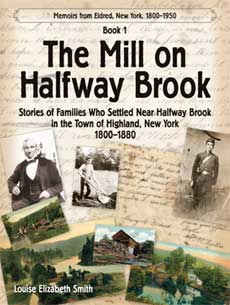
It was the beginning of December 1815. A lone log house and sawmill stood silently on almost two acres of cleared land near the middle of Halfway Brook, in the Town of Lumberland, New York. There were no other buildings around for a mile in any direction.
So starts Chapter One in The Mill on Halfway [...]
Chapter 1 The Town of Lumberland 1798 to 1815

March 20th, 2010 · No Comments
Tags: Book excerpts · The Mill on Halfway Brook
Some Upper Delaware River Cities
October 23rd, 2009 · No Comments
Cochecton
In 1754, Connecticut Yankees established Cushetunk and claimed the Delaware River’s west bank for the Colony of Connecticut.
Cochecton, (cuh-SHEK-ton), means low land; also called the flats. The land is rich and fertile and full of fish and game.
Narrowsburg
Narrowsburg has the narrowest and deepest points on the upper Delaware River.
Tusten (Ten Mile River)
Tusten at [...]
Tags: Book excerpts
River Rafting
October 22nd, 2009 · No Comments
In 1800, Lumberland (then two years old), had a population of 733, most of whom had lumber-related jobs. Saw-mills operated on various streams. Halfway Brook was said to have had ten sawmills on its nine miles.
Enormous amounts of lumber were made into rafts and floated down one of the many rivers or brooks in the [...]
Tags: Book excerpts
Halfway Brook Village and Brook
October 20th, 2009 · No Comments
The Halfway Brook (there is another one in New York) I write about, is in a most gorgeous area called the Upper Delaware River Region, in New York State. This Halfway Brook was the name of a nine-mile stream, before it became the name of the Village which is now Eldred.
Halfway Brook flowed [...]
Tags: The Mill on Halfway Brook
Sawmills in Lumberland
September 22nd, 2009 · No Comments
In 1798 when it was created, the Town of Lumberland was a rugged wilderness with 300,000 acres of continuous forests, interspersed with ponds, lakes and streams. The brooks and streams flowed into the Delaware River, which was the southwest border between New York and Pennsylvania.
A number of sawmills were built on the streams which flowed [...]