Butterless, Eggless, Milkless Cake

I am currently working on the second time through the World War II years and found this recipe of my grandma Myrtie Briggs. I know that sugar was rationed, so I wouldn’t think this cake could be made too often.

Canadian War Cake or Butterless, Eggless, Milkless Cake
2 cups brown sugar
2 cups hot water
4 tablespoons lard
1 teaspoon salt
1 teaspoon cinnamon
1 teaspoon cloves or nutmeg
1 cup raisins

1. Boil together for five minutes after they begin to bubble.
2. When cold add 3 cups flour and 2 teaspoons of soda dissolved in 1 teaspoon hot water.
3. Line pans with oil paper.
4. Bake in two loaves in a slow oven for 1-1/4 hours.

Posted in Farewell to Eldred, Recipes, World War II | 4 Comments

1940 Unknown Boarding House Owners

Once again I could use some ID help with the following folks who were listed in the 1940 Census as having a boarding house. Thank you.

Karl Angerstein, 59, widower owned a boarding house.

Gus and Frieda Dasener ran a boarding house on Minisink Ford-Barryville Road.

Mimie Rupp, 63, widowed, ran a boarding house also on Minisink Ford-Barryville Road.

Walter and Barbara Kramer, also on on Minisink Ford-Barryville Road.

Bertha Sullivan, summer and hunting season lodgers.

Posted in Boarding Houses, Farewell to Eldred, Info/photo request | 7 Comments

Maple Syrup Time

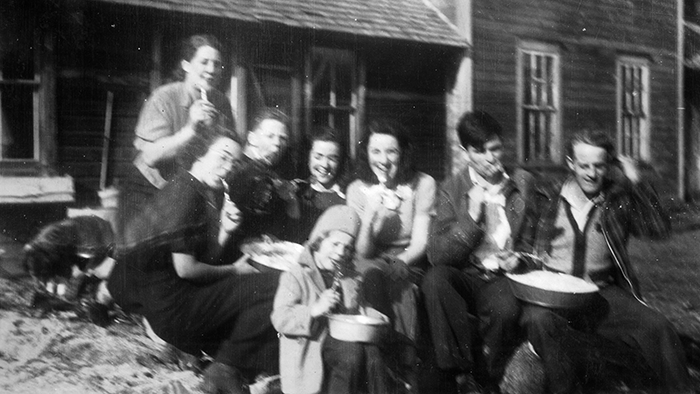
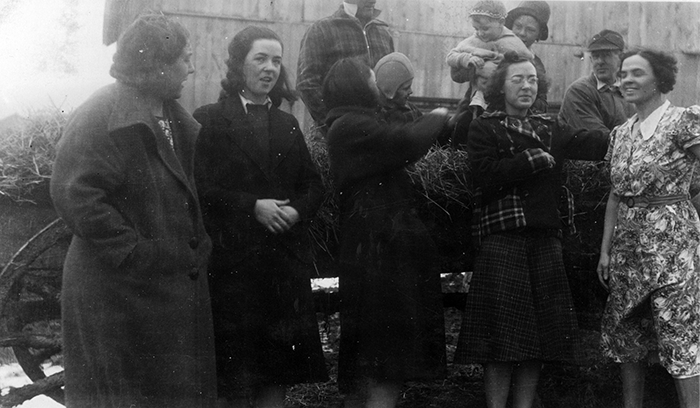
Standing on left: Bessie Hill, her son Billy Lass. Cecelia Sullivan, the Algebra teacher in front of Billy. Joan Hill, the young girl in front. The other girls are Cecelia’s sisters. Art Austin next to Alfred Hill on the right.
Another photo of the maple sugar group. Photos in Austin Family Collection.

Ceclia Sullivan was one of the Eldred teachers who boarded at Alfred and Bessie Hill’s place. One year at sugaring time, Alfred, Bessie, their children Billy Lass and Joan Hill, and Art Austin went to Cecelia’s home. They feasted on maple syrup drizzled over snow.

Posted in Farewell to Eldred | Comments Off on Maple Syrup Time

October to December 1917

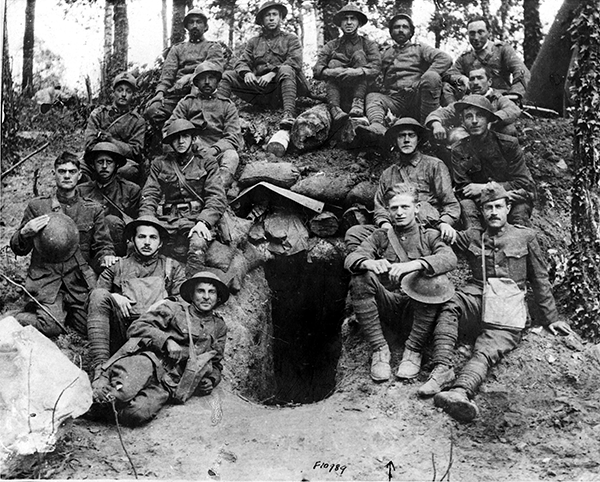
November 3, 1917. “I am sending you some pictures I had taken in Chickamauga (Georgia).” McKinley is in front, second from the right. Photo in the Austin Collection.
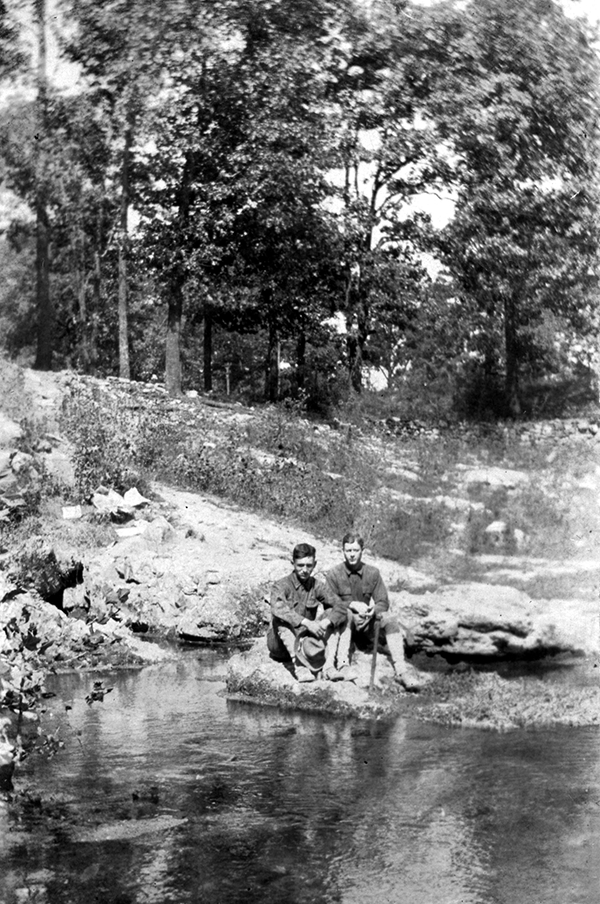
McKinley (on the left) with a friend at Chickamauga, Georgia, possibly at Crawfish Springs, mentioned in his November 3, 1917 letter. Photo in the Austin Collection.

McKinley Austin, Chickamauga Park, Ga., to Jennie Austin
October 7, 1917
Dear Ma,
I am sorry you were worried about me. I might say though that it is best to always believe the best; you’ll hear of the worst. I have learned since I joined the army not to worry.

I would have written sooner this time, but we had 24 hours in the trenches, a long hike, and a couple of sham battles and I have been so tired when the day’s work was over, I didn’t feel like writing. The strike is over and we can go to Chattanooga when it doesn’t interfere with our duties. McKinley

McKinley Austin, Chickamauga Park, Ga., to Mort Austin
November 3, 1917
Dear Father,
I got out of the hospital alright. I wish I could get off and come home for a couple of weeks, but they are only giving short passes now.

I am sending you some pictures I had taken in Chickamauga. One of the pictures is of me on the bridge below Chickamauga, another of two fellows from the 52nd down at Crawfish Springs, another of another fellow and me at the same place and the other of a place on the road to Chickamauga. Continue reading

Posted in Austin letters, Echo Hill and Mountain Grove, World War I | Comments Off on October to December 1917

Have you heard of any of these boarding houses?

I have one more chapter to complete on boarding houses from 1925 to 1930 and my rough draft will be complete. There are a few folks who owned boarding houses that I have no info on. I am hoping one of Halfway Brook readers might be able to help me out.

Dorthea Gent, 46, boarding house, 1925

Rose McQuirk, 55, boarding house, 1925

Louise? Nashour 34, boarding house, 1925

Gus 37, and Barbara 33, Rothenbeck boarding house 1925

Mrs. Holden, 1930

Mary Hankins ran Rosemary Lodge, 1930

Alice McCaffry, manager, boarding house, 1930

Posted in Boarding Houses, Do you know who I am, Farewell to Eldred | 2 Comments

WWI Stamps and Certificates

1918 U.S. Thrift Card in the collection of Mary A.
1918 inside of the U.S. Thrift Card in the collection of Mary A.

War Saving Stamps and Certificates were provided for in the bond act of September 24, 1917, and put in operation December 3, 1918.

Thrift stamps cost 25 cents each, but did not accrue interest. Sixteen thrift stamps on a thrift card could be exchanged for a war-savings stamp.

The war-savings stamps were to be affixed to certificates containing spaces for 20 stamps.

It had a face value of $100, if dated January 2, 1918. It matured January 1, 1923, when the Govern-ment said it would redeem it for $100.

If the 20 spaces were filled during December 1917, or January 1918, the cost was $4.12 for each stamp, or $82.40 for the full certificate.

Posted in Echo Hill and Mountain Grove, Uncategorized, World War I | Comments Off on WWI Stamps and Certificates

August 1917

McKinley Austin, Chattanooga, Tenn., to Aida Austin, Eldred
August 4, 1917
Dear Aunt,

I am here and like it better than at Fort Slocum. We get better food and the officers seem better, though we had a fine sergeant there. It took over 34 hours to come here, counting from the time we left the barracks at Ft. Slocum, till we got here.

If I am lucky, and come back, I wouldn’t miss this for five thousand dollars. The trip down to here was worth a year of a man’s life. I’ll never forget it. I am sure. For the present, my address is: Mortimer Austin, 11 U.S. Inf., F Company, Military branch, Chattanooga, Tennessee.

Your nephew, McKinley

McKinley Austin, Chattanooga, Tenn., to His Family, Eldred
August 4, 1917
To all family, relations, friends,

I am very well and certainly like this place. We left Port Jervis on the morning train instead of the 12:15. Of the 15 applicants, only 2, Al Delaney and I went. We were examined at Poughkeepsie and a bunch of us, 13 in all, were sent to Ft. Slocum. We got there late at night. Sunday we were examined again and four were sent back. Also we were vaccinated and inoculated for typhoid. My vaccination didn’t take, but the inoculation did.

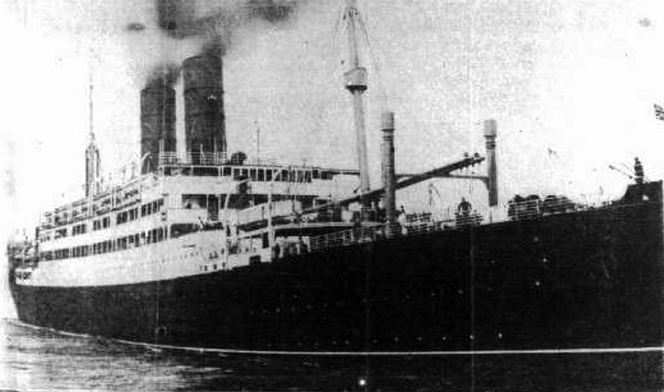
Monday we got our uniforms and were assigned to our squads. Tuesday afternoon, we were told to get ready to go South. And we were examined again. About 7:30, we left our barracks, turned in our blankets and marched to the parade ground. The commander inspected us. Then we were sent aboard a ship and sent down the East River. Continue reading

Posted in Echo Hill and Mountain Grove, People, World War I, World War II | Comments Off on August 1917

Dear Soldier Boy, April 1917

McKinley Austin at his aunt Aida Austin’s house, 1917. Photo courtesy of Mary A.

My Tuesdays are meatless
My Wednesdays are wheatless
I am getting more eatless each day.
My house is heatless
My bed is sheetless
They’ve all been sent to the Y.M.C.A..
The bar rooms are treatless
My coffee is sweetless,
Each day I get poorer and wiser
My stockings are feetless
My trousers are seatless
Oh how I do hate the Kaiser.

Quite a poem, is it not?

Well let’s hope that there will soon be an end to this awful war.
—Your friend, Ruth Colville.

In 1917 McKinley (Mac) Austin (my dad’s oldest brother) enlisted in the Army for WWI. Raymond Austin would also enlist.

Ruth Colville who lived in Barryville at the time, was one of McKinley’s friends who wrote to him.

Posted in Echo Hill and Mountain Grove, People | Comments Off on Dear Soldier Boy, April 1917